
Are you aspiring to become a Junior Engineer (JE) in the Electrical department of the Indian Railways? The Railway Recruitment Board (RRB) JE Electrical exam is a fantastic opportunity, and with the right strategy, you can definitely crack it in 2025! This comprehensive guide will walk you through the exam pattern, syllabus, previous year cut-offs, and crucial preparation tips, enhanced with visuals to make your journey smoother.
Understanding the RRB JE Electrical Exam
The RRB JE Electrical selection process generally involves two Computer-Based Tests (CBTs): CBT 1 and CBT 2, followed by document verification and medical examination. Let’s delve into the details.
RRB JE Electrical Exam Pattern 2025
It’s vital to understand the structure of both CBT 1 and CBT 2.
CBT 1 Exam Pattern
CBT 1 is a qualifying exam, and its marks are not considered for the final merit list. However, you must clear it to be eligible for CBT 2.
| Subject | Number of Questions | Marks | Duration |
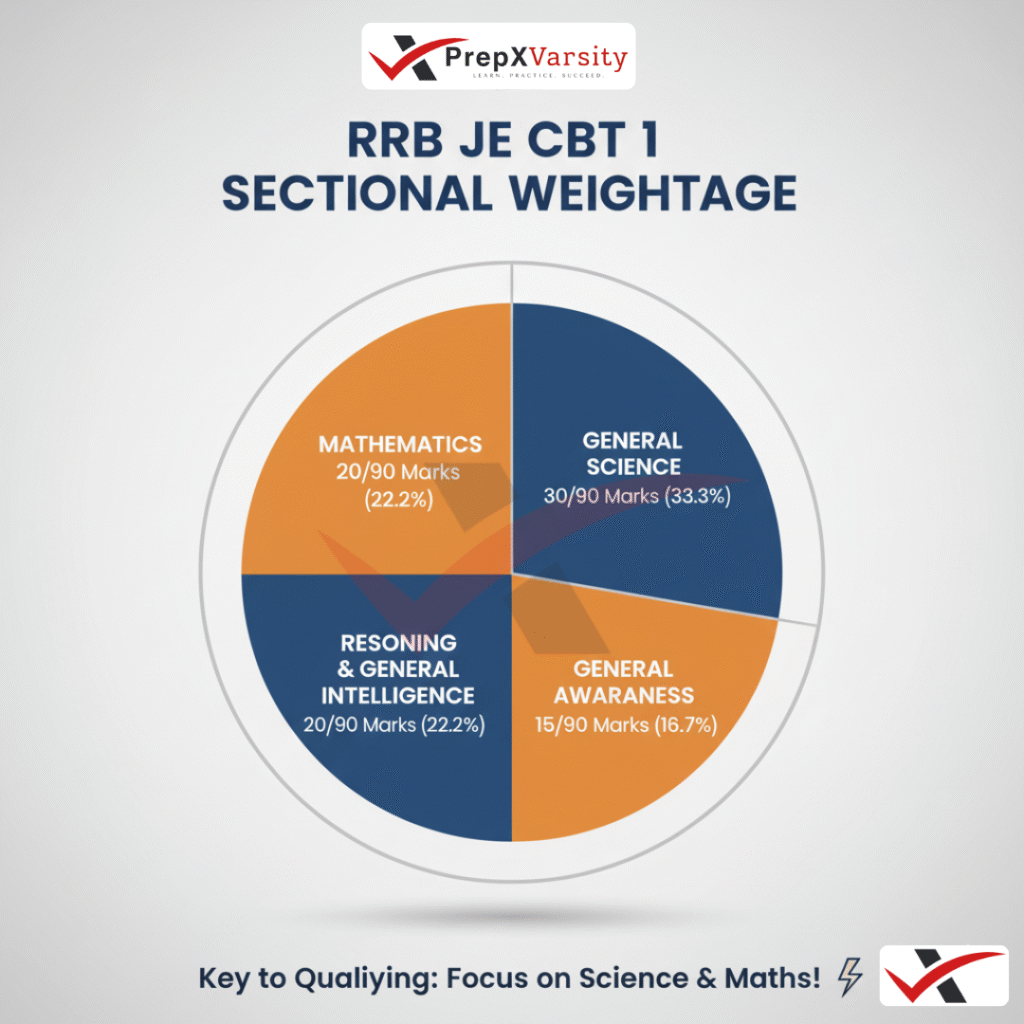
| General Awareness | 15 | 15 | |
| Reasoning & General Intelligence | 20 | 20 | 90 minutes |
| Mathematics | 20 | 20 | |
| General Science | 30 | 30 | |
| Total | 90 | 90 |
Export to Sheets
Key Points for CBT 1:
- Negative Marking: 1/3rd mark will be deducted for each incorrect answer.
- Minimum Qualifying Marks: Generally, 40% for Unreserved, 30% for OBC/SC, and 25% for ST. These may vary, so always check the official notification.
CBT 2 Exam Pattern
CBT 2 is where your technical knowledge and general awareness are thoroughly tested, and its marks are crucial for your final selection.
| Subject | Number of Questions | Marks | Duration |
| General Awareness | 15 | 15 | |
| Physics & Chemistry | 15 | 15 | |
| Basics of Computers Applications | 10 | 10 | 120 minutes |
| Basics of Environment & Pollution Control | 10 | 10 | |
| Technical Abilities (Electrical Engineering) | 100 | 100 | |
| Total | 150 | 150 |
Export to Sheets
Key Points for CBT 2:
- Negative Marking: 1/3rd mark will be deducted for each incorrect answer.
- Minimum Qualifying Marks: Similar to CBT 1, generally 40% for Unreserved, 30% for OBC/SC, and 25% for ST.
Here’s an infographic summarizing the exam patterns:
RRB JE Electrical Syllabus 2025
A detailed understanding of the syllabus is your roadmap to success.
CBT 1 Syllabus:
- Mathematics: Number Systems, BODMAS, Decimals, Fractions, LCM, HCF, Ratio & Proportion, Percentage, Mensuration, Time & Work, Time & Distance, Simple & Compound Interest, Profit & Loss, Algebra, Geometry, Trigonometry, Elementary Statistics, Square Root, Age Calculations, Calendar & Clock, Pipes & Cistern.
- General Intelligence & Reasoning: Analogies, Alphabetical & Number Series, Coding & Decoding, Mathematical Operations, Relationships, Syllogism, Jumbling, Venn Diagram, Data Interpretation & Sufficiency, Conclusions & Decision Making, Similarities & Differences, Analytical Reasoning, Classification, Directions, Statement – Arguments & Assumptions.
- General Awareness: Knowledge of Current Affairs, Indian Geography, Culture and History of India including freedom struggle, Indian Polity and Constitution, Indian Economy, Environmental issues concerning India and the World, Sports, General scientific and Technological Developments.
- General Science: Physics, Chemistry, and Life Sciences (up to 10th standard CBSE syllabus).
CBT 2 Syllabus:
- General Awareness: Current Affairs, Indian Geography, Culture and History of India including freedom struggle, Indian Polity and Constitution, Indian Economy, Environmental issues concerning India and the World, Sports, General scientific and Technological Developments. (Similar to CBT 1 but with a slightly higher difficulty level).
- Physics & Chemistry: Up to 10th standard CBSE syllabus, with a focus on practical applications and fundamental concepts relevant to engineering.
- Basics of Computers Applications: Architecture of Computers, Input & Output devices, Storage devices, Networking, Operating Systems like Windows, Unix, Linux, MS Office, various Data Representation, Internet & Email, Websites & Web Browsers, Computer Virus.
- Basics of Environment & Pollution Control: Basics of Environment, Adverse effect of environmental pollution, pollution control strategies, types of pollution, Global warming, Acid Rain, Ozone depletion, Solid waste management.
- Technical Abilities (Electrical Engineering):
- Basic Concepts: Concepts of resistance, inductance, capacitance, and various factors affecting them.
- Circuit Law: Kirchhoff’s law, mesh and nodal analysis, network theorems (Thevenin’s, Norton’s, Superposition, Maximum Power Transfer).
- Magnetic Circuit: Concepts of flux, MMF, reluctance, different kinds of magnetic materials, electromagnetic induction.
- AC Fundamentals: Instantaneous, peak, RMS, average values of alternating waves, representation of AC quantities, phaser analysis, AC circuits with R, L, C, resonance.
- Measurement and Measuring Instruments: Types of instruments, errors, PMMC, MI, Electrodynamometer type instruments, energy meters, power factor meters, instrument transformers, digital voltmeters and multimeters, CRO.
- Electrical Machines: DC machines (generators and motors), transformers, induction motors (single and three-phase), synchronous machines (generators and motors), special machines.
- Power Systems: Generation, transmission, and distribution of electrical power; types of power plants, switchgear, protection, substations, underground cables, overhead lines, power factor improvement.
- Basic Electronics: PN junction diode, rectifiers, transistors (BJT, FET), amplifiers, oscillators, digital electronics (logic gates, flip-flops, counters).
- Utilisation of Electrical Energy: Illumination, electric heating, welding, traction, electric drives.
- Estimation and Costing: Estimation of internal wiring, external wiring, overhead and underground lines, material estimation.
- Power Electronics & Drives: Thyristor, SCR, various controlled rectifiers, choppers, inverters, speed control of DC and AC motors.
Here’s a visual representation of the key Electrical Engineering subjects:
Previous Year Cut-Offs (Indicative)
Understanding previous year cut-offs gives you a target score to aim for. Please note that cut-offs vary significantly based on the number of vacancies, the difficulty of the paper, and the number of candidates appearing.
Here’s an example of CBT 1 (Stage-I) cut-offs for RRB JE (Electrical) from a previous cycle (these are approximate and can vary by zone and year):
| Category | CBT 1 Cut-off (out of 100) |
| UR | 65-72 |
| OBC | 60-68 |
| SC | 52-60 |
| ST | 45-55 |
| Ex-Servicemen | 40-48 |
Export to Sheets
And for CBT 2 (Stage-II) for RRB JE (Electrical) from a previous cycle (these are approximate and can vary by zone and year):
| Category | CBT 2 Cut-off (out of 150) |
| UR | 95-105 |
| OBC | 90-100 |
| SC | 80-90 |
| ST | 70-80 |
| Ex-Servicemen | 60-70 |
Export to Sheets
Note: Always refer to the official RRB notification for the most accurate and up-to-date information on cut-offs and qualifying marks once it is released for 2025.
RRB JE Electrical 2025: Preparation Strategy & Tips
Now that you have a clear picture of the exam, let’s craft a winning preparation strategy.
Phase 1: CBT 1 Preparation (Foundation Building)
Since CBT 1 is qualifying, aim to clear it comfortably.
- Strong Hold on Basics (Mathematics & General Science):
- Mathematics: Practice daily. Focus on speed and accuracy. Use NCERT textbooks for classes 8-10 as a base. Solve problems from competitive exam books.
- General Science: This section has a high weightage. Review Physics, Chemistry, and Biology concepts from NCERT textbooks (Class 6-10). Pay attention to daily life applications.
- Reasoning & General Intelligence:
- Practice a variety of questions. Start with basic concepts of each topic and gradually move to complex problems.
- Focus on topics like coding-decoding, series, analogies, syllogism, and data interpretation.
- General Awareness:
- Current Affairs: Read newspapers daily, follow monthly current affairs magazines/websites. Focus on national and international news, sports, awards, government schemes, and major scientific developments.
- Static GK: Cover Indian History, Geography, Polity, and Economy. Use a reliable General Knowledge book.
- Time Management: Since you have 90 questions in 90 minutes, practice solving questions quickly. Don’t spend too much time on a single question.
- Mock Tests: Take regular CBT 1 mock tests. Analyze your performance to identify strong and weak areas. This helps in improving time management.
Here’s a chart illustrating the importance of each section in CBT 1:
Phase 2: CBT 2 Preparation (Merit-Based)
This phase requires intensive focus on your core Electrical Engineering subjects.
- Technical Abilities (Electrical Engineering – 100 Marks!):
- Thorough Understanding: Don’t just memorize formulas; understand the underlying concepts.
- Standard Textbooks: Refer to standard Electrical Engineering textbooks for each subject. For example, for Basic Electrical Engineering (B.L. Theraja or V.K. Mehta), Electrical Machines (P.S. Bimbhra), Power Systems (C.L. Wadhwa).
- Focus on Key Areas: Give extra attention to Electrical Machines, Power Systems, Basic Electronics, and Circuit Theory, as these often carry significant weightage.
- Problem Solving: Practice a wide range of numerical problems and conceptual questions.
- Short Notes: Create crisp, short notes for quick revision, especially for formulas, key concepts, and important points.
- General Awareness, Physics & Chemistry, Computer Basics, Environment Basics:
- General Awareness: Continue updating current affairs.
- Physics & Chemistry: Reinforce concepts from CBT 1, focusing on practical applications.
- Computer Basics: Understand fundamental concepts of computer hardware, software, networking, and common applications.
- Environment & Pollution Control: Focus on basic concepts, types of pollution, and control measures. This section is often overlooked but can be a scoring area.
- Previous Year Papers: Solve RRB JE and other similar JE exam previous year papers. This helps you understand the exam pattern, question types, and difficulty level.
- Mock Tests (Crucial for CBT 2):
- Take full-length CBT 2 mock tests regularly.
- Analyze your performance in detail: identify where you’re losing marks (conceptual error, silly mistake, time issue).
- Work on improving speed and accuracy under timed conditions.
- Revision: Consistent revision is key. Review your notes and solved problems regularly.
General Tips for Both Phases
- Create a Study Plan: Develop a realistic and well-structured study plan. Allocate specific time slots for each subject and stick to it.
- Quality over Quantity: Focus on understanding concepts thoroughly rather than just mugging up.
- Stay Updated: Keep an eye on the official RRB website for any notifications or changes.
- Stay Healthy: Maintain a healthy lifestyle with proper sleep, diet, and exercise. A fresh mind performs better.
- Positive Mindset: Believe in yourself and stay motivated throughout your preparation journey.
Here’s an infographic summarizing the overall preparation tips: